
Cyprus does not need a New Zealand-style housing crash to feel housing pain. The more important warning is quieter: when property becomes the economy's confidence engine, even flat prices can start to behave like a macro shock.
New Zealand is useful because the story did not begin with bad banks or a failed state. It began with a long, socially accepted assumption that housing wealth would keep rising, supporting household spending, renovation, refinancing and construction employment. Bloomberg, NZ Adviser and Reserve Bank of New Zealand reporting now show the reverse side of that mechanism: house prices are still around 15% to 20% below pandemic-era peaks, the official cash rate was held at 2.25% in February 2026, and unemployment reached 5.4%. Monetary easing helped, but it did not immediately restore the old wealth effect.
The phenomenon: property as confidence infrastructure
The named risk is property-as-confidence infrastructure. In a normal property cycle, prices rise, affordability tightens, supply responds, and buyers adjust. In a property-dependent economy, the asset price itself becomes part of the growth model. Homeowners spend because collateral values rise. Banks lend because collateral looks safer. Developers launch because absorption feels permanent. Governments collect transfer taxes and construction-linked revenue. Then the cycle stops reinforcing itself.
That is why the New Zealand example matters for Cyprus. The direct comparison is not that Cyprus is already in a bust. It is the opposite: Cyprus is still showing strength. Central Bank of Cyprus reporting for Q4 2025 put the Residential Property Price Index up 7.1% year on year, with apartment prices up 9.6%. Eurostat's PRC_HPI_Q series put Cyprus house prices up 6.0% year on year in Q4 2025, close to the EU27 rate of 5.5%. DLS data reported through the Real Estate Agents Registration Council and Cyprus Mail showed 18,114 sales documents in 2025 and transfer value above EUR4.7 billion.
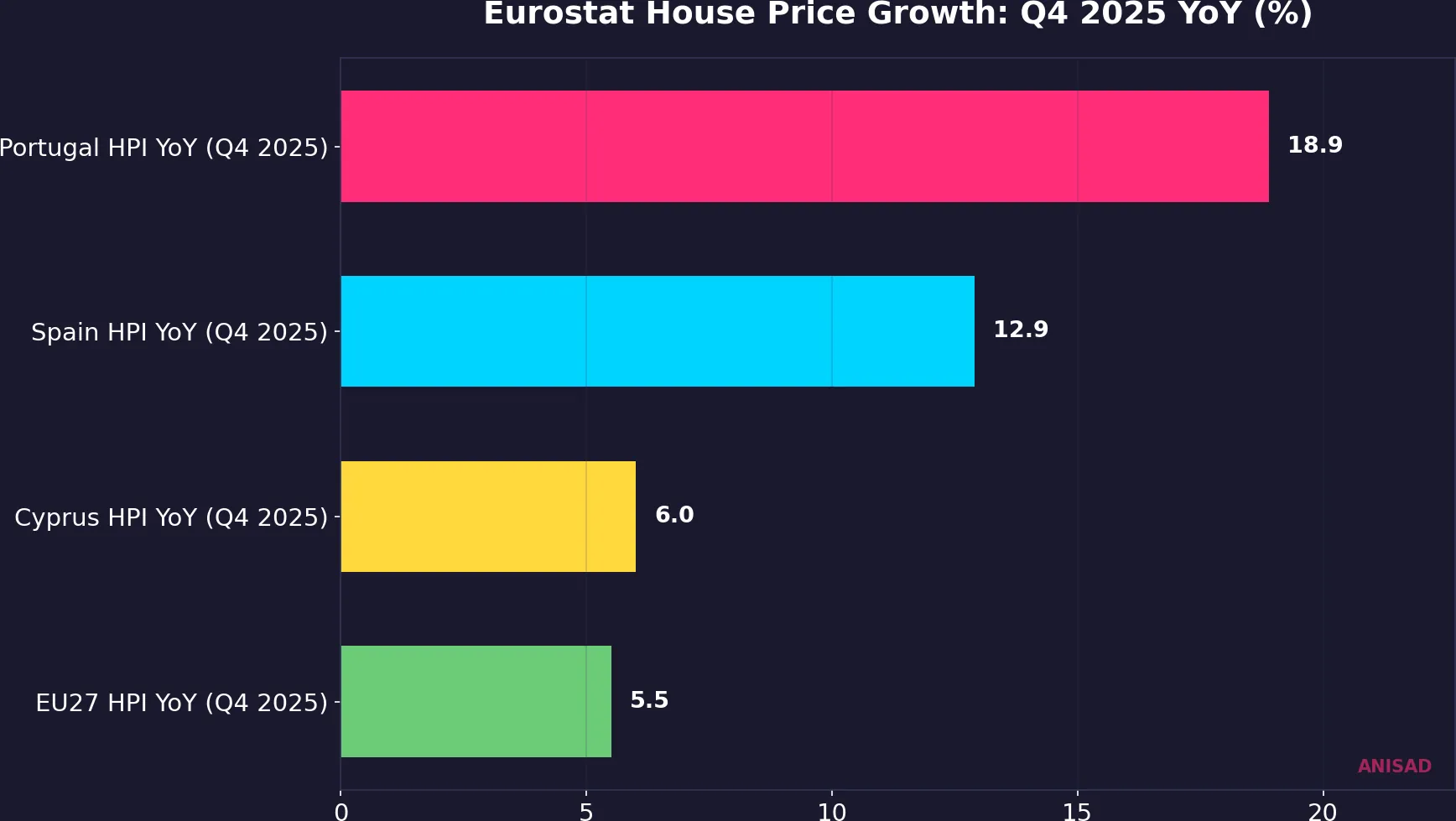
The Cyprus risk is dependence, not a crash forecast
A 6% to 10% price-growth market does not look fragile on the surface. The vulnerability appears when too many local assumptions depend on that growth continuing. In Cyprus, the sensitive links are apartment prices, foreign-buyer liquidity, off-plan launches, land values, bank collateral and household confidence. A market can remain solvent while becoming less liquid; it can keep reported prices high while transactions slow; and it can damage the real economy through delayed projects, cautious consumers and tighter lending before headline prices fall sharply.
This is the lesson from New Zealand's policy trade-off. Cutting rates can ease debt service, but if households no longer believe property is a one-way wealth machine, spending does not automatically rebound. Holding policy tighter can defend inflation credibility, but it prolongs pressure on leveraged borrowers. Either path is more difficult after a housing boom has been allowed to carry too much of the confidence burden.
Mediterranean precedents show the tail risk
The international comparison is not academic. Spain's pre-crisis credit cycle showed how property concentration can migrate into banks: ECB Working Paper 2245 documents construction and real estate firms reaching 48% of bank lending to firms in 2007. Greece shows the price-cycle tail: Alpha Bank research reported a 42.4% residential property price fall from the Q3 2008 peak to the Q3 2017 trough. These are not forecasts for Cyprus, but they are downside boundaries for economies where property, credit and confidence become entangled.
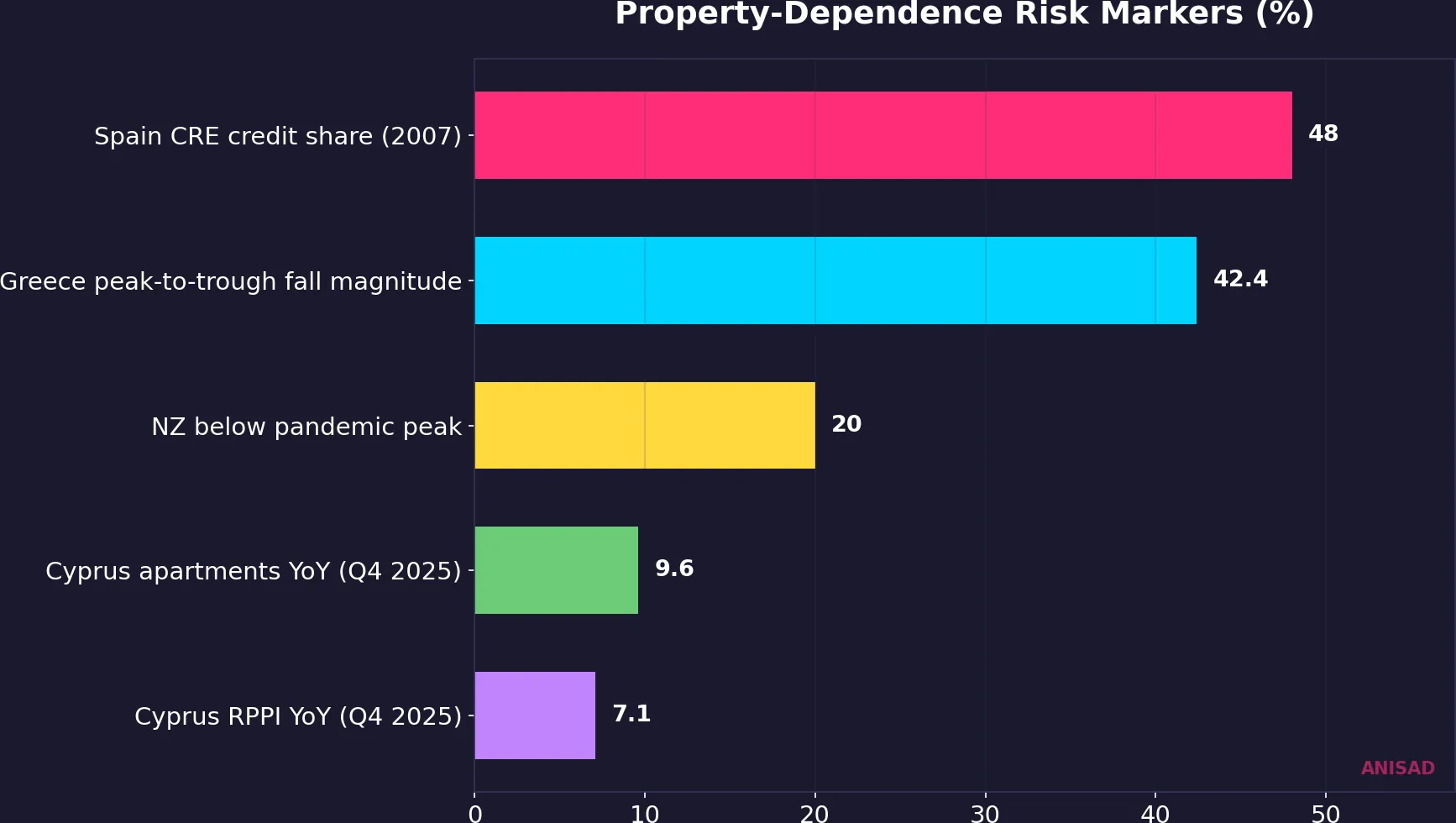
Who wins and who loses if the wealth effect fades
The winners are not necessarily buyers waiting for a crash. They are operators with low leverage, banks with conservative loan-to-value books, developers tied to real end-user demand, and investors who can underwrite rent rather than resale optimism. Their advantage is patience and liquidity.
The exposed groups are easier to identify: highly leveraged recent buyers, speculative off-plan investors, developers carrying land at peak-cycle assumptions, agents dependent on transaction velocity, and local households whose affordability is stretched by apartment inflation. The most important loser can be the wider consumer economy. When property no longer makes households feel richer, discretionary spending, renovation demand and small-business confidence can weaken with a lag.
A reader playbook for Cyprus property risk
Use New Zealand as a dashboard, not a prophecy. First, watch transaction volume before prices: a liquidity freeze usually arrives before forced repricing. Second, separate apartment inflation from house-price averages, because apartments are where Cyprus demand pressure is most visible. Third, follow credit quality and bank collateral language, not only mortgage rates. Fourth, model each investment against two years of flat resale prices. If the thesis only works with appreciation, it is not an income asset; it is a confidence trade.
What would falsify the risk thesis
The warning would be less urgent if Cyprus price growth cooled while transactions stayed broad-based, wages caught up with housing costs, rental yields remained supported by local incomes rather than short-stay or foreign-buyer assumptions, and banks kept lending standards stable without a rise in arrears. That would look like normalization. The danger scenario is different: sales documents slow, developers continue launching supply, apartment prices flatten, and banks quietly tighten collateral assumptions at the same time.
The bottom line
Cyprus is not New Zealand. But New Zealand proves that the wealth effect is not a free stabilizer; it is borrowed confidence. When property-heavy economies treat rising home values as a substitute for diversified productivity, the eventual adjustment does not stay inside the housing market. It spreads into consumption, credit, construction and politics. For Cyprus, the disciplined position is not panic. It is to stop underwriting property as if appreciation were a public utility.
Data sources: Bloomberg feature on New Zealand housing boom and bust, May 2026, NZ Adviser / Reuters reporting on New Zealand house prices, OCR and unemployment, February 2026, Reserve Bank of New Zealand OCR statement, 18 February 2026, Central Bank of Cyprus Residential Property Price Index, Q4 2025, Eurostat PRC_HPI_Q, annual house price change, Q4 2025, Department of Lands and Surveys / Real Estate Agents Registration Council via Cyprus Mail, 2025 sales documents and transfer values, ECB Working Paper 2245 on Spanish bank credit exposure, Alpha Bank Greece Insights on residential property peak-to-trough decline