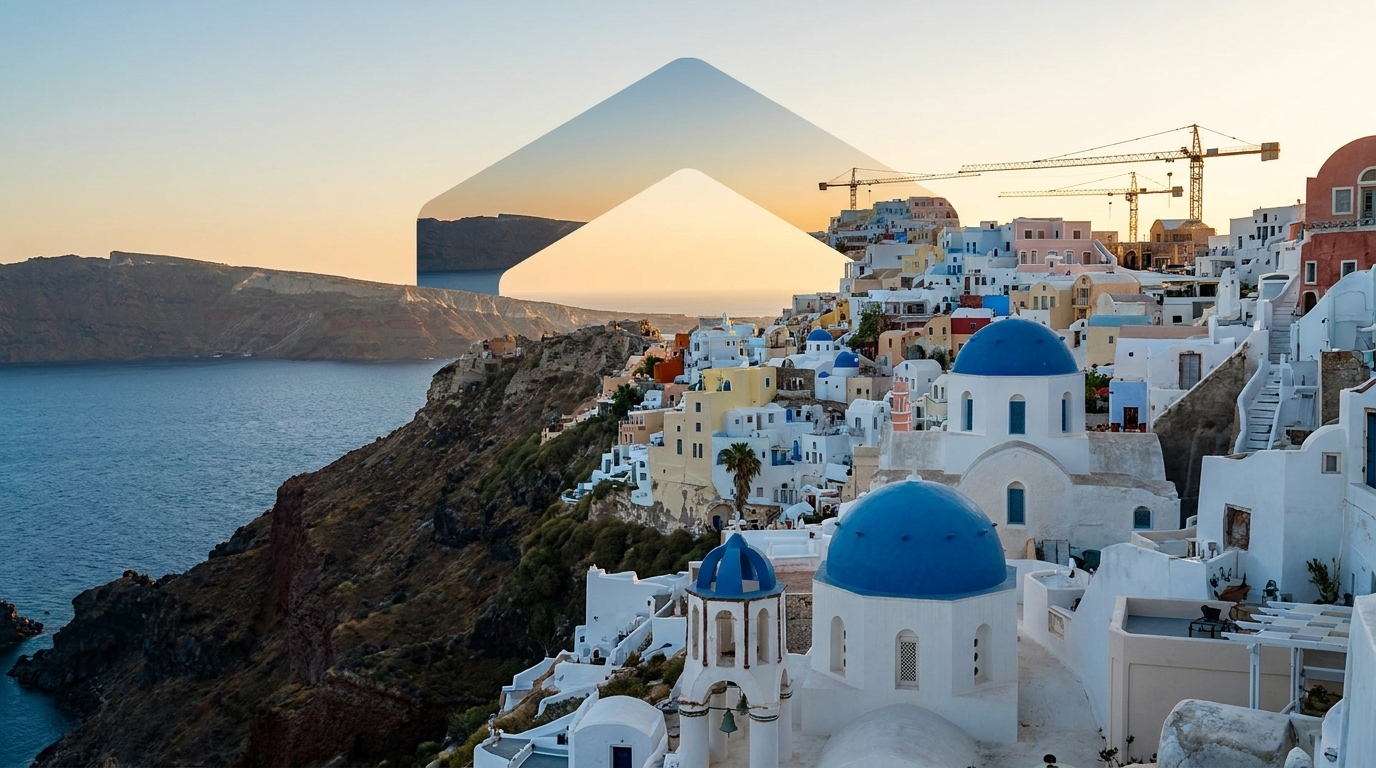
Greece has drawn a line in the sand. With the formal introduction of its Special Spatial Framework for Tourism in May 2026, the Greek government has imposed the strictest construction restrictions ever placed on its most visited islands. Mykonos, Santorini, Skiathos, and parts of Rhodes, Zakynthos, and Crete now fall under Category A — "saturated" — a designation that caps new tourist accommodation at 100 beds, mandates minimum hotel plot sizes of 1.6 hectares, and imposes carrying-capacity assessments before any new development can proceed. This is not a planning tweak. It is a structural shift in how one of Europe's most tourism-dependent economies manages the relationship between visitors, land, and long-term livability.
The Trigger: Record Tourism Meets Local Backlash
The numbers explain the urgency. Greece welcomed 37.98 million visitors in 2025, a 5.6% increase over 2024, generating EUR 23.6 billion in travel revenue — up 9.4% year-over-year. Revenue growth consistently outpaced arrival growth, with average spending per trip reaching EUR 602 in the first ten months of 2025. The tourism machine has never been more productive. But its physical footprint on the Aegean islands has become unsustainable.
Between 2020 and 2023, 461 new hotels opened on Greece's southern Aegean islands, with 126 opening in 2023 alone. Locals on Mykonos and Paros have struggled to find affordable housing as short-term rentals colonized residential stock. Water shortages, waste management strain, and the erosion of cultural identity pushed island communities into open protest. The Greek government's response has been to intervene at the planning level, not merely with tourist taxes or visitor caps, but with hard restrictions on what can be built and where.
What the Framework Actually Restricts
The Special Spatial Framework divides Greece into five development categories based on tourism saturation levels. The classification determines what can be built, how large it can be, and under what environmental conditions.
Category A — Saturated (18 municipal units): The most restrictive tier covers Mykonos, Santorini, Skiathos, and selected zones in Rhodes, Zakynthos, and Crete. New tourist accommodations are capped at 100 beds (approximately 50 rooms). Hotels require a minimum plot of 1.6 hectares. Environmental impact assessments are mandatory, and short-term rental conversions face outright bans in designated areas. In the Cyclades specifically, bed capacity reductions of 20 to 30 percent are under consideration relative to previous development plans.
Categories B through E (84 to 528 municipal units each) impose progressively lighter restrictions, with Categories D and E actively incentivizing low-impact tourism development in underdeveloped regions. A special fee supporting the Green Fund applies to Categories A, B, and C. Local planning rules can override national guidelines, giving municipalities direct control over development density.

Mykonos and Santorini: Ground Zero
Both islands have been under outright building permit freezes since 2023, extended through December 31, 2026. On Mykonos, out-of-plan construction is banned entirely. Tourist facility spacing has been tripled from 10 to 30 acres. Protected areas now cover approximately two-thirds of the island, and land available for tourism and residential development has been reduced by 20 percent. The freeze originated after a 2023 incident involving an attack on an archaeologist investigating illegal building activity — a signal of how contentious development had become.
Santorini's restrictions are even more severe within the Caldera zone: no new constructions, no additions, no swimming pools, no water infrastructure. Analysts estimate that under the new Special Urban Plans, only single-digit plots remain immediately usable for development. Most other properties would require complex property pooling arrangements to meet the new minimum-size thresholds. The result is a near-total development freeze on the islands that generate the highest per-square-meter property values in Greece.
Mykonos property prices stood at EUR 7,622 per square meter in April 2026, up modestly from EUR 7,565 a year earlier. The scarcity effect has not yet translated into explosive price growth — but with buildable land supply contracting sharply, market participants expect upward pressure to intensify once the permit freezes are lifted and the new framework's constraints become fully binding.
A Mediterranean-Wide Pattern
Greece is not acting in isolation. The construction cap joins a growing family of overtourism regulations spreading across Mediterranean destinations, each calibrated to local politics but pointing in the same direction: less building, fewer short-term rentals, higher taxes on visitors.
Barcelona doubled its tourist tax in April 2026, with holiday rental guests now paying up to EUR 12.50 per night. Mayor Jaume Collboni has announced plans to ban short-term rentals entirely by 2028. The city received 16 million visitors in 2025 and faced major anti-tourism protests in the summer. Twenty-five percent of the new tax revenue is earmarked for the housing crisis. Venice introduced the world's first day-tripper access fee — EUR 5 per person during peak periods — alongside a ban on large cruise ships in the historic center and a 25-person cap on walking tour groups.

What distinguishes Greece's approach is its structural ambition. Barcelona and Venice are managing visitor flows through pricing and access control. Greece is restricting the physical supply of tourism infrastructure — a far more permanent intervention that directly shapes the property market for decades. Once development rights are reduced or eliminated, they do not easily return.
What This Means for Cyprus and Regional Capital Flows
The real estate implications extend well beyond the Aegean. When development opportunities contract in one Mediterranean market, capital migrates. Spain's anti-foreign-buyer rhetoric in 2025 produced a measurable 17% drop in non-EU property purchases — and concurrent acceleration of investor interest in Cyprus, Portugal, and Greece itself. Greece's construction caps introduce a new variable: investors who would have developed hospitality or residential projects on Mykonos, Santorini, or Skiathos now face either higher entry costs (scarce land) or need to look elsewhere entirely.
Cyprus sits in a particularly interesting position. Its own foreign buyer restrictions are tightening in 2026, with caps on non-EU land purchases and five-year holding requirements. But Cyprus has not imposed tourism-driven construction limits. The island's building permit pipeline remains relatively open compared to the Greek islands, and its planning framework does not include saturation classifications or bed caps. For hospitality developers priced out of Category A Greek destinations, Cyprus offers a regulatory environment that is restrictive on buyer nationality but not on development density — a meaningful distinction for capital seeking Mediterranean tourism exposure.
What to Watch
Three indicators will determine whether Greece's experiment reshapes Mediterranean property markets or remains a localized planning adjustment:
- Land price trajectory on Category A islands: If buildable plot values on Mykonos and Santorini spike sharply once the permit freeze lifts in 2027, it confirms that supply restriction is creating scarcity premiums rather than cooling the market.
- Capital flow redirection signals: Watch for increases in hospitality-sector building permits on Crete's less-restricted coasts, Cyprus's Paphos and Larnaca districts, and emerging Mediterranean destinations like Albania's Riviera — all of which compete for the same investor pool.
- Regulatory contagion: If Spain, Italy, or Croatia adopt similar spatial frameworks with saturation classifications and bed caps, the pattern becomes a Mediterranean norm rather than a Greek exception. Portugal's new housing legislation and Croatia's Dubrovnik visitor caps suggest the political appetite exists.
The Bigger Picture
Greece's construction caps mark a turning point in Mediterranean real estate policy. For the first time, a major tourism economy has chosen to permanently restrict the supply of its most valuable development land — not through market forces, but through regulatory classification. The political logic is clear: island communities are voting against the externalities of tourism growth, and governments are responding with structural interventions rather than cosmetic taxes.
For investors, the framework creates a two-tier Mediterranean property market. Tier one — saturated, restricted, high-value islands — becomes a scarcity play where existing assets appreciate but new development is nearly impossible. Tier two — less-restricted coasts in Cyprus, Crete's southern shores, and emerging Mediterranean destinations — absorbs the development capital that can no longer deploy in the Cyclades. Understanding which tier a property sits in, and which direction regulation is moving, is now as important as understanding price-per-square-meter or rental yield.
Data sources: Ekathimerini (Greek Special Spatial Framework, May 2026), Naftemporiki (Tourism Spatial Framework categories), GreekReporter (Mykonos and Santorini building restrictions, May 2026), ProtoThema (Santorini permit extension, March 2026), Euronews (Greece tourism statistics 2025), GTP Headlines (Greece tourism arrivals and revenue Jan-Oct 2025), Argophilia (Special Spatial Framework announcement), Indomio (Mykonos property market data, April 2026)