In the upper echelons of European real estate, a quiet revolution is underway. The traditional hierarchy of value — location, size, condition — is being rewritten by a generation of designers who treat interiors not as decoration but as embedded, non-replicable assets. Belgium, of all places, is at the center of this shift.
The Market Context: Quality Over Square Meters
The European luxury residential market was valued at USD 644 billion in 2026, growing at a 4.83% CAGR toward USD 816 billion by 2031, according to Research and Markets. But inside that vast number, a structural change is reshaping what luxury actually means. Christie's Real Estate Belgium reports that capital-strong buyers in 2026 prioritize state-of-the-art finishes and future-proof energy performance over raw square footage. Quality outweighs quantity. Provenance — the history, architectural context, and emotional identity of a property — now plays a role in valuation comparable to the art market.
The European luxury interior design market itself stands at approximately USD 30 billion and is forecast to reach USD 54 billion by 2034, growing at 6.8% annually. This is not interior decoration as a service category — it is a value creation layer that directly influences per-square-metre pricing.
The Belgian Warm Minimalism Movement
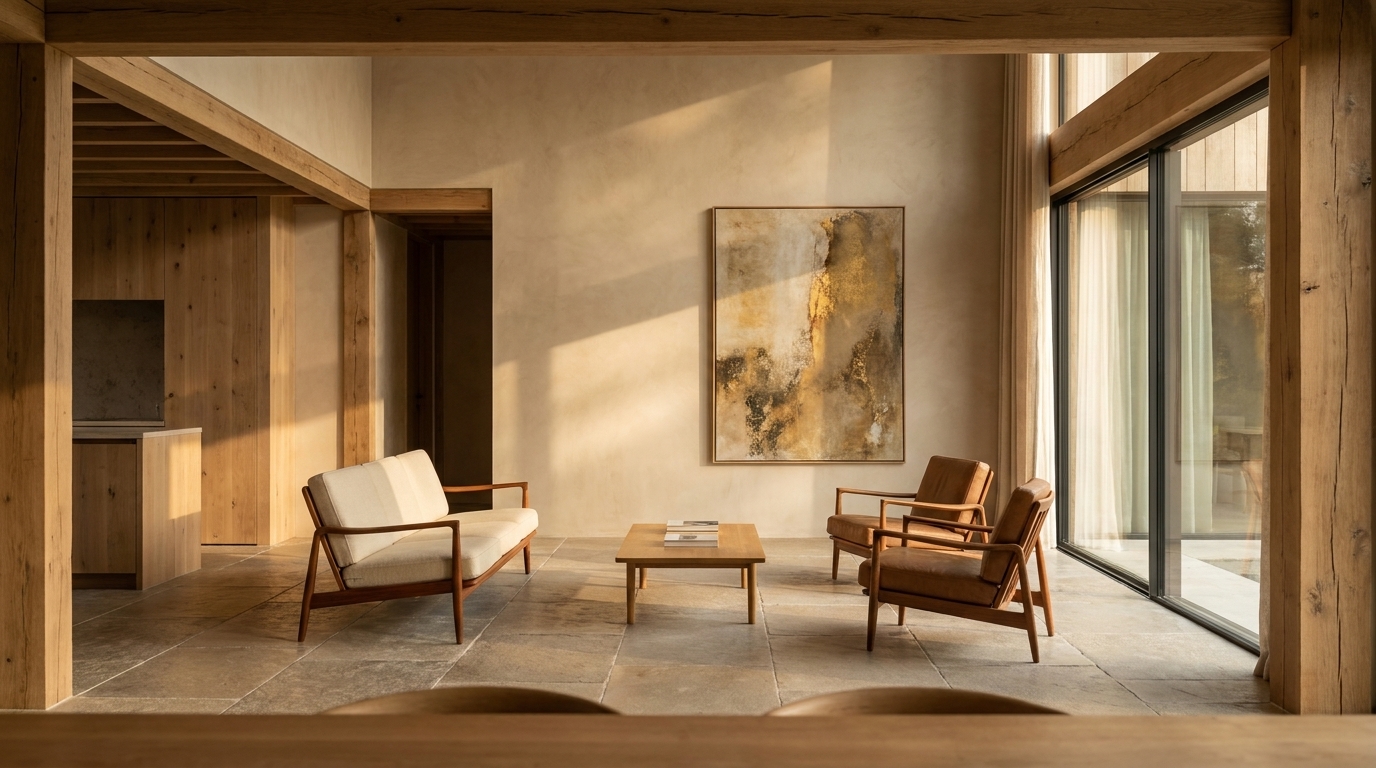
Five studios and designers have emerged as the defining voices of what can only be called a Belgian design manifesto: Amber Dewaele, BRUT Collective, Decancq Vercruysse, Middernacht & Alexander, and Charles Van Canneyt. What they share is not a uniform aesthetic but a common disposition — restraint as editorial judgment, material honesty over surface spectacle, and the conviction that how a space feels matters as much as how it functions.
Van Canneyt, who trained under Claudio Silvestrin, Vincent Van Duysen, and Axel Vervoordt — three architects who between them defined much of the European minimalist interior canon — synthesizes those influences into spaces that layer contemporary art, mid-century furniture, and historical objects within limewashed walls and raw timber. His Holland Park I project in London, developed with Rundell Associates, deployed reclaimed and charred timber, clay plaster, and stone from Belgian and Austrian quarries. Middernacht & Alexander take a more radical approach: their How I Got Over series repurposes decommissioned underground diesel tanks from Belgian homes, preserving decades of corrosion and soil traces beneath epoxy and hand-mixed pigments whose formulas are never recorded — making each piece physically unrepeatable.
BRUT Collective's City Remnants project, exhibited at Milan Design Week and Athens' Carwan Gallery Annex, reconstitutes fragments of urban infrastructure — speed bumps, traffic barriers, pavement curves — into domestic objects that carry the memory of the city. The collective maintains a permanent exhibition space at Antwerp's Haptic House, reinforcing Belgium's position as a center for design that takes space as its medium rather than the shelf.
The Price Premium: Quantifying Design-Driven Value
The economic case for design as a value driver is not anecdotal. Architect-designed and interior-curated homes command measurable premiums across markets:
- London: architect-designed homes generate USD 300,000-450,000 in property value premiums on USD 3 million properties
- Dubai: a luxury development achieved a 30% price premium on final units through strategic interior design investment
- Sydney (Balgowlah): designer homes averaged AUD 2.58 million versus AUD 1.42 million for standard two-bedroom equivalents — an 82% premium
- Knokke-Heist (Belgium): EUR 6,404/sqm average, versus EUR 3,776/sqm for Flanders apartments — driven by affluent buyers who treat finish quality as non-negotiable

In Belgium specifically, the luxury segment exhibits distinct pricing behavior. Knokke-Heist commands EUR 6,404 per square metre on average, compared to EUR 2,609 in Blankenberge — a gap explained not by geography alone but by the concentration of quality-conscious, mortgage-free buyers who demand bespoke finishes. Prime Brussels neighborhoods like Ixelles reach EUR 5,979/sqm, where architectural individuality and interior provenance carry significant weight.

The Collectible Design Ecosystem
The convergence of design and real estate value is not happening in isolation. Brussels' Collectible fair, now in its ninth edition, brought over 100 exhibitors to the Vanderborght Building in March 2026. Its New York expansion — the third edition, scheduled for September 2026 at the WSA building in the Financial District — signals that the Belgian design ecosystem has crossed from local scene to international export brand.
When Collectible co-founder Liv Vaisberg notes that at the New York editions "people were queuing round the block from day one," the implication for real estate is direct: collectors and specifiers who discover Belgian design at fairs become the same buyers who demand it in their homes. The fair's 2026 Brussels edition introduced TABLESCAPES, a new section exploring design as a lived, relational practice — a deliberate move to position collectible design not as gallery art but as inhabitable identity.
From Design Movement to Pricing Moat
The implications for developers and property investors are structural. For developers targeting the top quartile of the Belgian and broader European market, access to this design ecosystem is becoming a competitive moat rather than a styling afterthought. When architects like Decancq Vercruysse shape bespoke residential projects — as they did with a 1960s bungalow renovation in Sint-Martens-Latem, intensifying its horizontal logic with Afromosia veneer, stone tiles, and custom steel-and-wood detailing — they embed value that resists commoditization.
Engel & Volkers reports that references to artisan craftsmanship in luxury listings increased by 21% in 2025-2026, while vintage and provenance elements rose 17%. The market signal is clear: design narrative is migrating from marketing copy into actual price formation.
True luxury value derives from irreplaceable locations, unique architecture, and configurations that current constraints make nearly impossible to replicate — not just from price tags.
Stakeholder Impact
Winners: Luxury property developers in Belgium and London who commission bespoke interiors from named designers; the Brussels creative ecosystem benefiting from affordable rents and government support; collectors treating design pieces as alternative assets that appreciate independently of the property market.
Under pressure: Generic fit-out contractors competing on price alone; mass-market minimalism brands that cannot match the narrative depth or material honesty these studios deliver; developers in secondary locations where design-driven premiums are harder to capture.
Forward Look: What to Watch
Over the next 12-24 months, expect Belgian warm minimalism to become a recognizable brand in European luxury real estate marketing, similar to how Scandinavian design defined a previous generation. The Collectible fair's New York expansion will accelerate transatlantic visibility. Developers in Brussels, Ghent, and Antwerp are expected to increasingly anchor premium residential projects around named-designer interiors, lifting both per-square-metre prices and marketing distinctiveness.
The trend toward repurposed and narrative-rich materials — exemplified by Middernacht & Alexander's diesel-tank furniture — aligns with ESG preferences among institutional real estate investors. Belgium is assembling not a single star name but a dense network of studios that share materials, exhibitions, and a philosophical DNA. If the country monetizes this the way Denmark monetized hygge, Belgian minimalism becomes a pricing premium in residential transactions from Knokke to Kensington.
Conclusion
The luxury real estate market is entering a phase where interior identity is no longer an add-on — it is a core component of asset valuation. Belgian designers are proving that restraint, material honesty, and editorial judgment create value that generic specification cannot replicate. For investors, developers, and buyers in the European luxury segment, the question is no longer whether design matters, but whether you can afford to ignore it.
Data sources: Research and Markets: Europe Luxury Residential Real Estate (2026-2031), Christie's Real Estate Belgium: Luxury Real Estate Trends 2026, Cognitive Market Research: Europe Luxury Interior Design Market 2026, Engel & Volkers: Interior Design Trends in Luxury Real Estate 2026, Collectible Design Fair Brussels 2026 Edition, Financial Times: Belgian Designers Profile April 2026, Immolytics Belgium Property Prices 2026