
For decades, Europe treated residential property as a market asset. Supply met demand. Capital flowed freely. Prices adjusted.
In 2025–2026, that framework quietly collapsed.
Housing is no longer discussed as an economic category. It is discussed as a political emergency.
In 2024–2025, the issue of housing affordability officially reached the European Parliament.
In analytical materials and public debates, deputies increasingly talk about how the real estate market has ceased to fulfill its social function.
In one of its key reviews, the European Parliament states explicitly:
“In many EU countries, housing and rental prices are rising much faster than incomes, undermining social stability and increasing inequality.”
The wording is dry, but the conclusion is clear:
housing is no longer considered a normal market commodity.
Spain: where pressure turned into policy
In Spain, the numbers stopped being abstract.
Between 2019 and 2024:
- average rents in Barcelona rose by over 45%
- in Madrid, by more than 35%
- wages increased by less than 10% over the same period
By early 2025, housing costs were absorbing 50–60% of disposable income for young households in major cities.
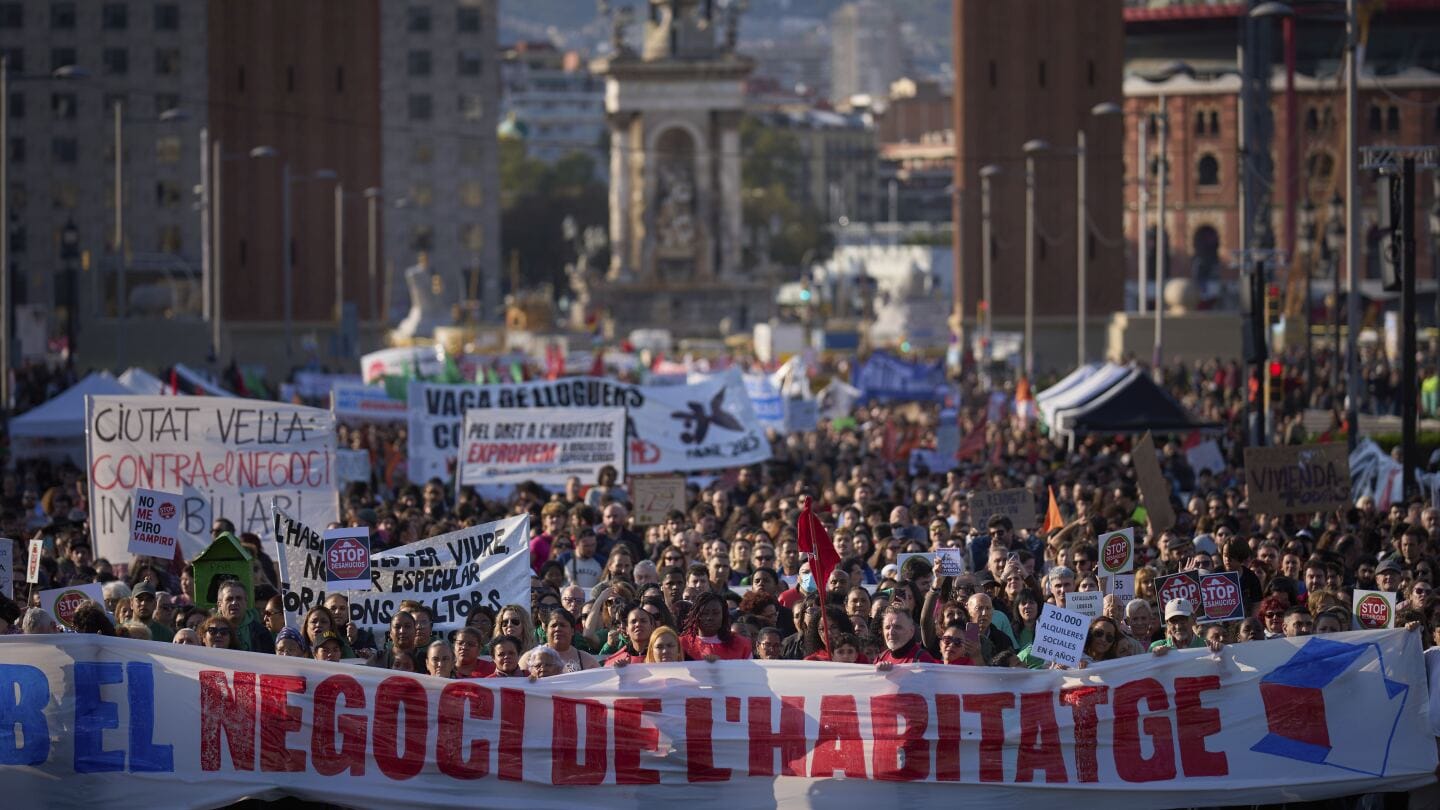
The protests that followed were not symbolic.

Protest imagery from Barcelona’s anti-speculation demonstrations (2019–2024)
Placards carried a simple message:
“Housing is a right, not an investment.”
At that moment, the market lost political immunity.
When leaders stop speaking in market language
Spain’s Prime Minister Pedro Sánchez publicly framed housing as a social failure, stating that governments “cannot allow residential property to function purely as a financial instrument.”
In policy terms, this signals a structural shift: markets are no longer protected from political intervention.
Regional governments went further.
Catalonia and the Balearic Islands openly discussed:
- restricting purchases by non-resident buyers
- raising transaction taxes for foreign investors
- tightening controls on short-term rentals
- penalising vacant investment properties
None of these measures are theoretical. Some are already law.
The data behind the backlash
According to land registry and notarial data:
- foreign buyers accounted for 14–15% of residential transactions in Spain in 2024
- in coastal regions and islands, that share exceeded 30%
- in premium urban districts, it reached 40%+
Politically, this concentration became impossible to defend.
As Financial Times noted in late 2025, Spain’s housing debate shifted from “how to build more” to “how to keep capital out.”
Investor Note
Markets rarely punish investors for losses. They punish them for being visible.
Spain is not an exception — it is an early signal
What is unfolding in Spain mirrors actions elsewhere:
- Canada imposed a nationwide ban on foreign residential purchases
- New Zealand implemented similar restrictions earlier
- Portugal removed property from its Golden Visa programme
- France and the Netherlands are tightening rental regulation
- Germany expanded rent controls across major cities
The pattern is unmistakable.
Housing is being reclassified — from asset class to political pressure valve.
Why this matters more than interest rates
Markets recover from monetary tightening. They adjust to price corrections.
They do not easily price in populism.
As Bloomberg observed in a 2026 outlook, capital today is less concerned with yield optimisation and more focused on regulatory calm.
The new premium is not return — it is predictability.
Investor Note
A 6% yield can be erased overnight. A rule change cannot.
Capital doesn’t protest — it migrates
Money does not argue with governments. It quietly relocates.
When jurisdictions begin framing investors as a problem, capital looks for places where it is treated as neutral.
Not celebrated. Not attacked. Simply accommodated.
Why Cyprus entered the conversation
In 2026, Cyprus rarely appears in housing crisis headlines.
That absence is strategic.
Cyprus has:
- not introduced bans on foreign buyers
- not weaponised housing politically
- not reframed property as a social enemy
- not revised rules retroactively
Its market has slowed — but it has not panicked.
In the current European climate, this restraint stands out.
Investor Note
Silence in policymaking is often more valuable than incentives.
The paradox of 2026
The louder a country speaks about “protecting locals,” the more cautiously capital treats it.
And the quieter a jurisdiction remains, the more attention it receives.
Not because it offers miracles — but because it avoids headlines.
The uncomfortable conclusion
Europe is entering a phase where:
- housing policy responds to street pressure
- capital is filtered, not welcomed
- stability matters more than growth
The winners of this cycle will not be the fastest-growing markets.
They will be the calmest.
Not because they are perfect — but because they resist turning housing into a slogan.