The Numbers Nobody Expected
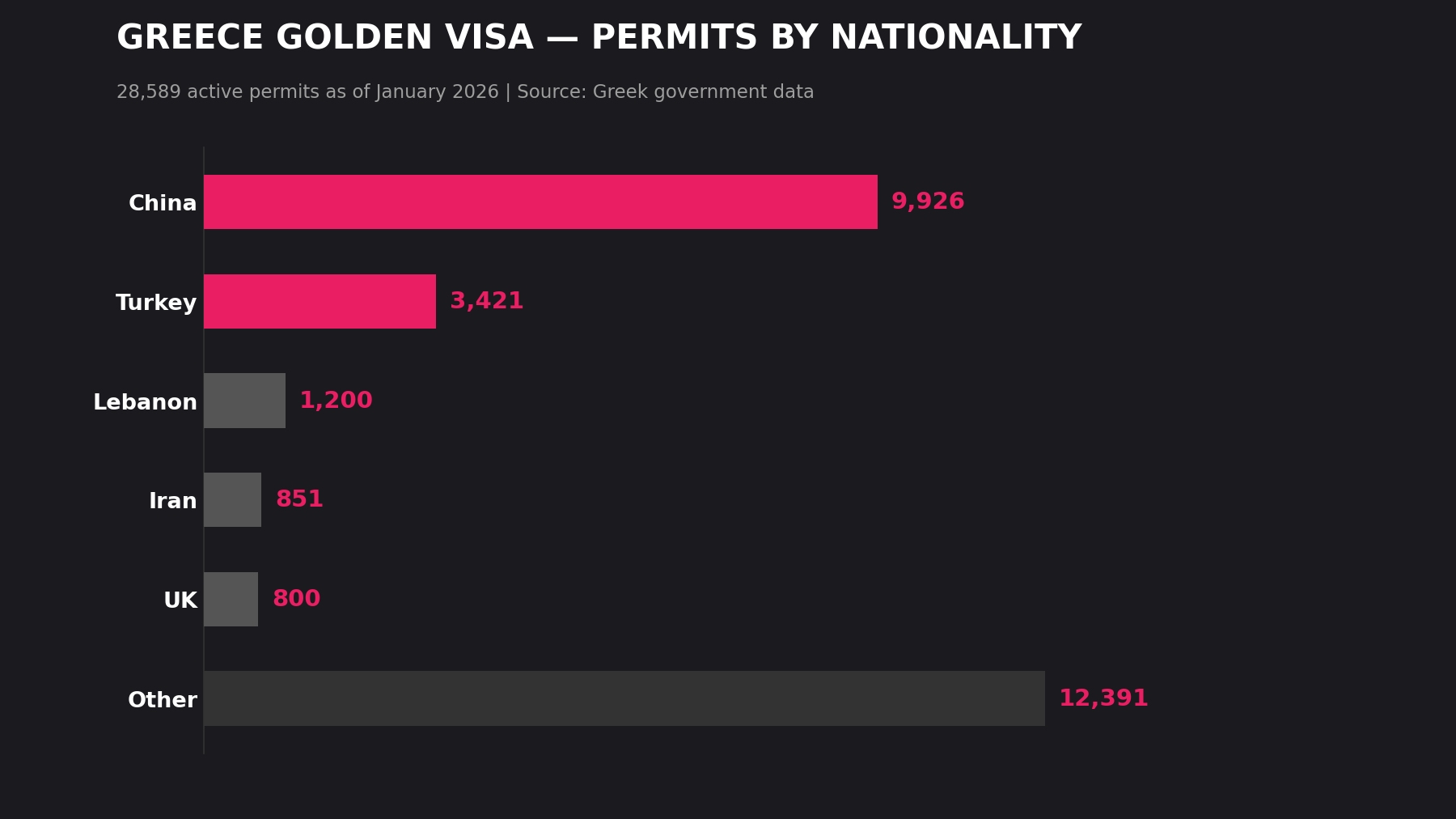
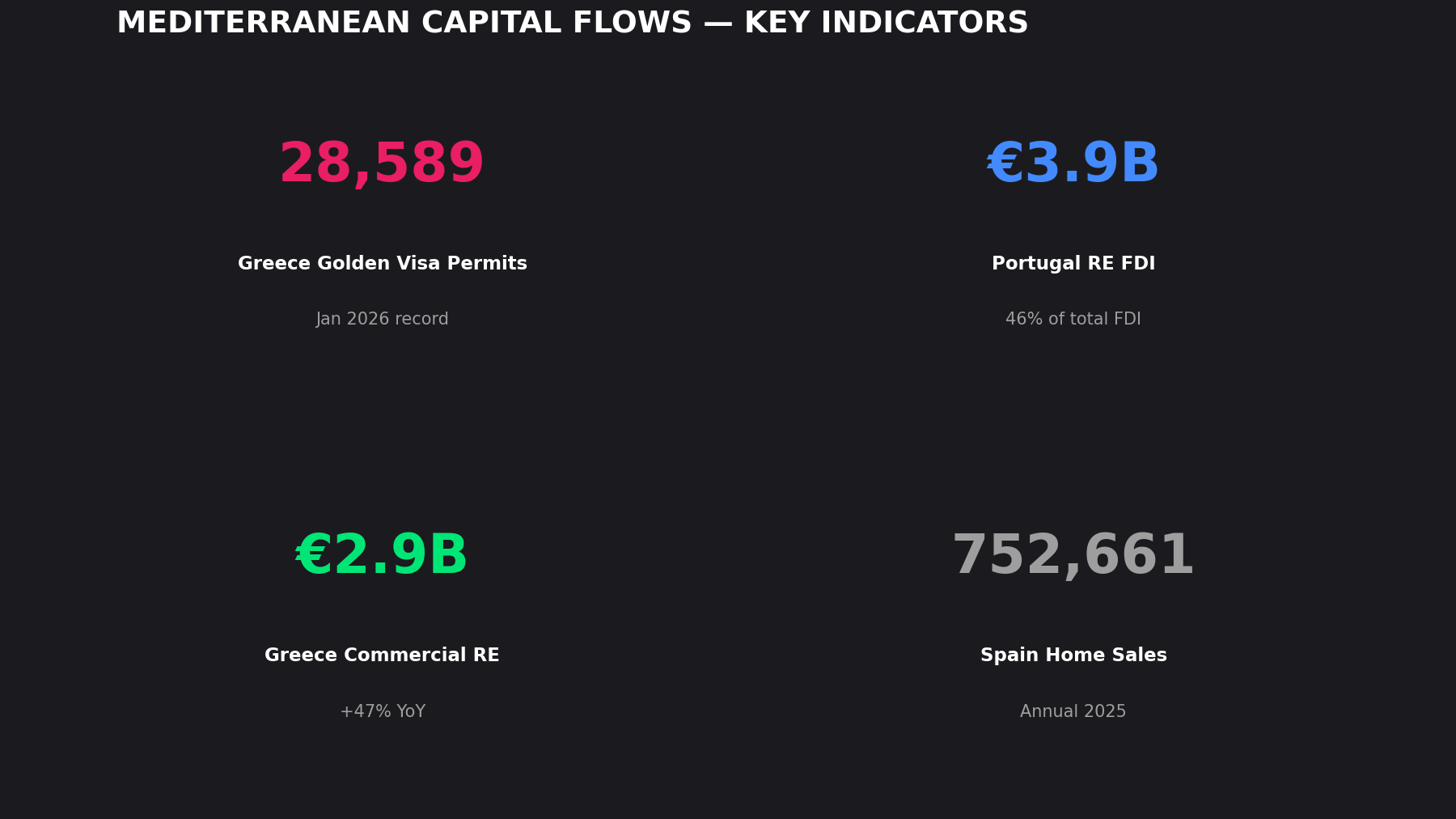
Greece's Golden Visa program just hit a milestone that should worry every competing Mediterranean destination: 28,589 active permanent residence permits as of January 2026. Of those, 21,393 represent initial grants to new investors — not renewals, not extensions, but fresh capital entering the Greek real estate market for the first time.
This happened despite Greece tripling its investment thresholds in high-demand areas to €800,000. It happened despite political pressure across the EU to restrict residency-by-investment programs. And it happened while Spain abolished its program entirely and Portugal reformed its own beyond recognition.
The conventional wisdom said higher barriers would slow capital flows. The data says otherwise.
Who Is Buying — And Why Now
The investor nationality breakdown reveals a story far more interesting than aggregate permit numbers. Chinese investors lead with 9,926 cumulative Golden Visa holders, maintaining their position as the single largest source of capital despite Beijing's ongoing capital controls. Turkish investors account for 3,421 resolutions (16% of total), while Iranian investors represent 851 permits (4%).
The Middle Eastern surge is the most structurally significant development. Israeli, Turkish, and Iranian investors have sharply increased their purchasing activity, driven directly by regional geopolitical instability. For these buyers, Greek real estate is not a lifestyle choice — it is a capital preservation strategy and an EU residency insurance policy.
The Competitive Landscape Has Shifted Permanently
The Mediterranean Golden Visa map of 2026 looks nothing like it did three years ago. Spain abolished its program in April 2025, citing housing affordability concerns in Madrid and Barcelona. Portugal eliminated direct property purchases from its Golden Visa pathway, redirecting investment toward funds, heritage renovation, and high-tech sectors. Cyprus ended its citizenship-by-investment program in 2020 following corruption scandals.
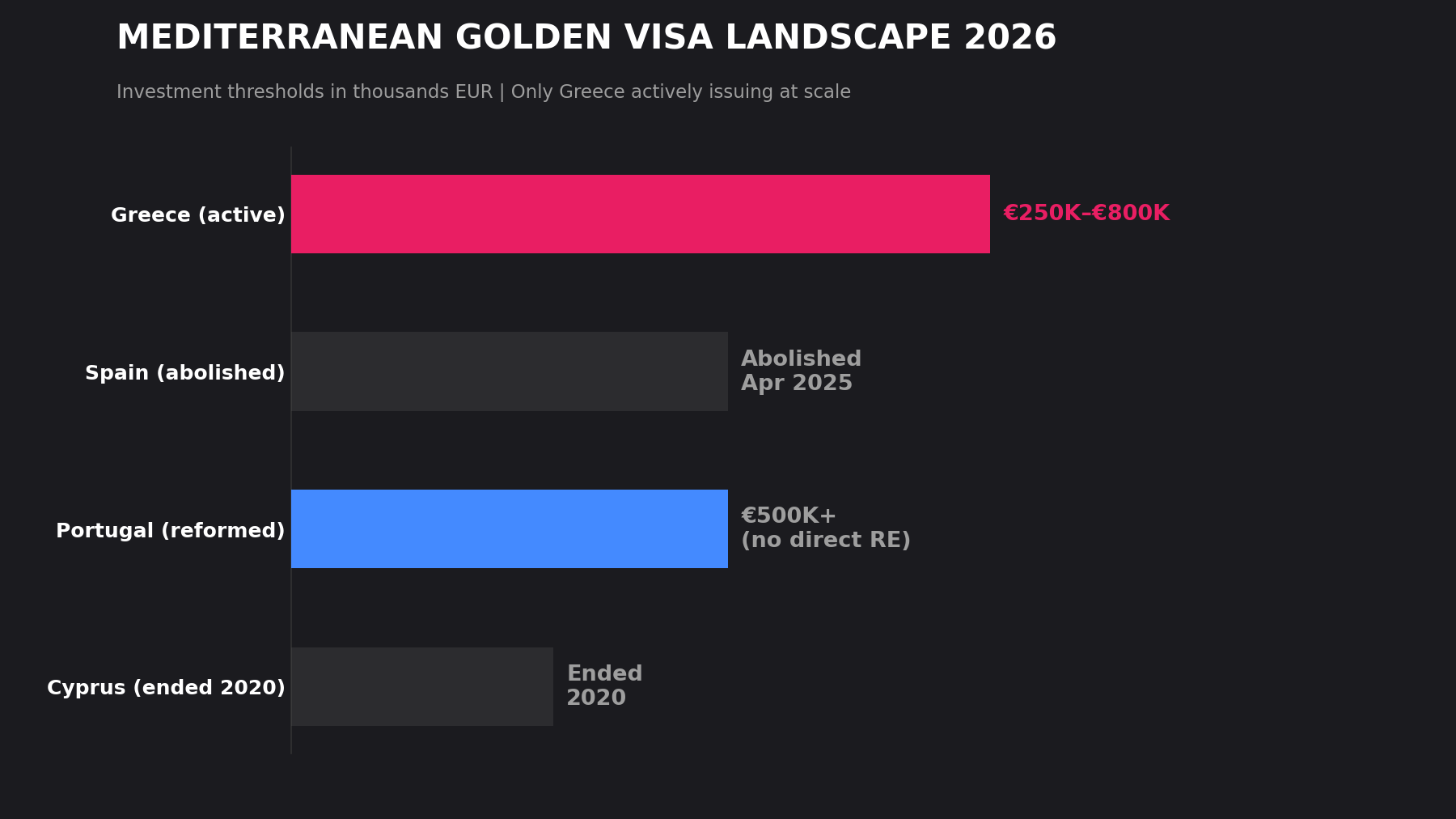
Greece is now the only Mediterranean country offering a straightforward real estate path to EU residency at scale. Its tiered system — €800,000 in Athens, Thessaloniki, and popular islands; €400,000 in other regions; €250,000 for heritage conversions — creates a natural demand distribution mechanism that other programs never achieved.
The Portugal Paradox
Perhaps the most counterintuitive data point comes from Portugal. Despite effectively ending its property Golden Visa, Portugal attracted a record €3.9 billion in real estate FDI in 2025 — representing 46% of the country's total foreign direct investment. Foreign buyers continued purchasing at volume even without the residency incentive, suggesting that Mediterranean real estate demand has decoupled from Golden Visa programs entirely.
Similarly, Spain recorded 752,661 home sales in 2025, with foreign buyer transactions remaining robust despite the Golden Visa abolition. The pattern is clear: Golden Visa programs amplify capital flows, but they do not create the underlying demand. That demand is driven by structural factors — weather, lifestyle, relative affordability versus Northern Europe, and increasingly, geopolitical safety.
What This Means for Cyprus
Cyprus occupies an awkward position in this new landscape. Its citizenship-by-investment program ended in 2020, and while a permanent residency pathway exists, it lacks the scale and marketing infrastructure that Greece has built. Monthly property transactions show 1,537 total sales with 430 non-EU transactions, suggesting steady but unspectacular foreign buyer activity.
The risk for Cyprus is not that investors stop buying — the island's fundamentals remain attractive. The risk is that the investor pipeline tilts decisively toward Greece, where the Golden Visa infrastructure creates a self-reinforcing ecosystem of immigration lawyers, property showcases, and secondary market liquidity. Every permit issued in Greece makes the next one easier.
The Structural Shift: From Lifestyle to Strategy
The most significant insight from the data is that Mediterranean real estate investment has evolved from a lifestyle choice to a strategic asset class. High-net-worth individuals from China, Turkey, and Iran are not buying vacation homes — they are building geopolitical insurance portfolios. An EU residence permit is a hedge against domestic political risk, capital controls, and conflict escalation.
This structural demand floor did not exist a decade ago. It creates a fundamentally different market dynamic: one where Mediterranean property prices have a built-in support level from capital that must find a safe destination, regardless of price levels or economic cycles.
Who Wins, Who Loses
Greek property developers, particularly those operating in the €400,000 tier regions outside Athens, are the clearest beneficiaries. Immigration advisory firms serving Middle Eastern and Chinese clients are experiencing unprecedented demand. Cash-rich investors who can meet the higher thresholds face less competition from marginal buyers priced out by the changes.
The losers are equally clear: local Greek renters and first-time buyers in tourist-heavy areas face continued price pressure. Competing destinations like Cyprus, Montenegro, and Malta must work harder to attract capital. And countries losing wealth — Iran, Turkey, China — face a slow but measurable brain and capital drain.
What to Watch Next
Three signals will determine whether this trend accelerates or plateaus:
- Greece's 30,000-permit threshold — expected by mid-2027, this milestone may trigger political pressure for further threshold increases or program modifications
- Iran war duration — the longer the conflict continues, the more structural the Middle Eastern capital migration becomes
- EU-level regulation — the European Parliament has called for harmonized standards on residency-by-investment, which could constrain Greece's program
The Mediterranean capital flow story is no longer about whether Golden Visa programs attract investment. That question has been definitively answered. The real question is whether the region's housing markets can absorb this capital without creating the affordability crises that led Spain and Portugal to restrict their programs in the first place.
Data sources: Greek government Golden Visa statistics (January 2026), Athens News, Travel and Tour World, Portuguese Ministry of Economy FDI data, Spanish National Statistics Institute, Eurostat, ECB bank interest rate statistics.